NexusRTC
Browser-based peer-to-peer video conferencing with password-protected rooms, waiting lobby, encrypted chat, screen share, and meeting recording. WebRTC mesh media + Socket.io signaling/chat, no account required.
←Use arrow keys or swipe to navigate→
The Problem
Most quick video calls are trapped between two bad options: enterprise tools that force account setup for a 5-minute discussion, or toy WebRTC demos that break as soon as real users join from different networks. Students and small teams need a browser-native room they can create instantly, protect with a password, and share with one link — with reliable signaling, lobby controls, chat, and screen share.
The hard part is not rendering a video element; it is building the production edge cases: waiting-room flow, session tokens, reconnect behavior, ICE restarts, secure recording downloads, room cleanup, and abuse controls (rate limiting, max peers, TTL). NexusRTC is built to close that gap: a practical 2–6 participant real-time calling system with no sign-up friction.
My Role & Constraints
Solo Full-Stack Engineer & Product Owner — I designed and shipped NexusRTC end-to-end.
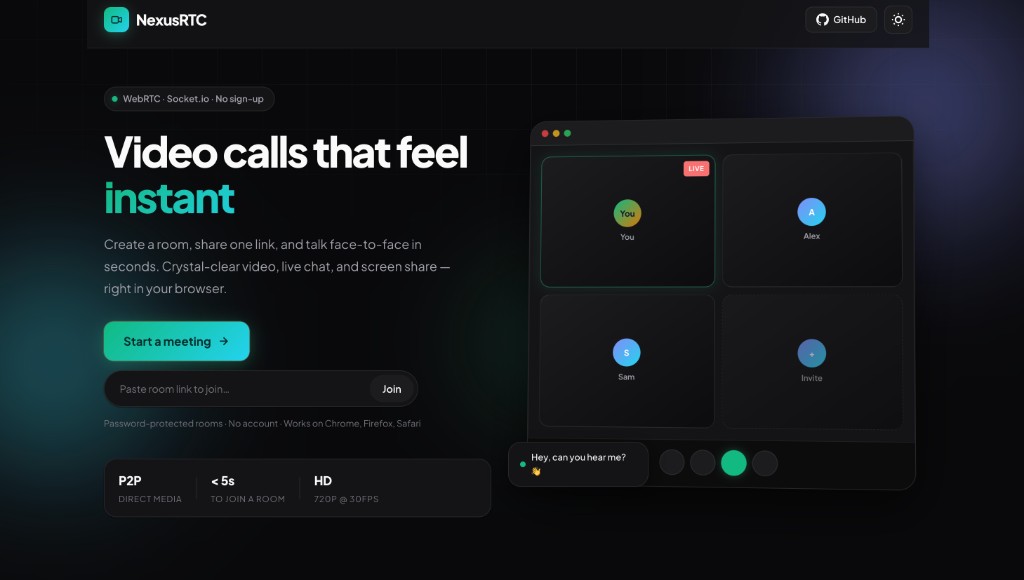
**Frontend:** Next.js 14 + React 18 + TypeScript app with dark/light UI, room creation and password gate, waiting-room screens, live participant grid layouts (Auto/Grid/Spotlight/Sidebar), in-call dock controls (mic/camera/screen-share/hand-raise/reactions/layout), encrypted chat panel, and recording status indicators.
**Realtime layer:** Socket.io for signaling + chat channels (/socket.io), peer lifecycle events, waiting-room moderation (admit/deny/admit-all), typing indicators, reaction broadcasts, and reconnect recovery.
**Media layer:** WebRTC mesh P2P for camera/audio/screen tracks with dynamic ICE config fetched from /api/ice-config; peer reconnection with ICE restart (iceRestart: true) on failed/disconnected states.
**Backend & security:** Custom Node server (server.js) with in-memory room state, bcrypt room passwords, session token auth, creator token for host rejoin, rate limiting, room TTL cleanup, recording upload auth, signed one-time recording downloads, and optional FFmpeg MP4 transcode pipeline.
System Design / Architecture
NexusRTC runs as a **single Node process** combining Next.js app routes and Socket.io realtime transport.
1$Browser A ◀──────── WebRTC mesh · SRTP media ────────▶ Browser B2$│ │3$└──────────────────┐ ┌──────────────────┘4$▼ ▼5$Single Node process (Render)6$┌───────────────────────────────────────────┐7$│ Next.js app + Socket.io signalling │8$│ /api/room/create · /api/room/verify │9$│ /api/ice-config · /api/recordings │10$│ in-memory rooms · bcrypt · session tokens │11$└───────────────────────────────────────────┘
**Core topology:** - Browser ↔ Browser: WebRTC media (SRTP) in mesh mode - Browser ↔ Server: Socket.io for signaling/chat/presence - Browser ↔ API routes: room create/verify, ICE config, recording upload/download, health
**Room flow:**
1. Host creates room via POST /api/room/create with room name + password.
2. Server stores room in memory (hashed password, lobby enabled, max peers, host token, session map).
3. Guest verifies password via POST /api/room/verify and receives session token.
4. Socket.io connects with { roomId, token }; if lobby is on, guest waits for host admission.
5. On admission, signaling (offer/answer/candidate) starts and peer mesh connects.
**Security model:** bcrypt (12 rounds) password hashes, UUID session tokens (TTL), creator token for host return, upload auth on recordings, signed one-time download tokens (1-hour TTL), and action-wise sliding-window rate limits.
**Recording path:** client MediaRecorder captures composite meeting view, uploads to POST /api/recordings, server stores private files outside public static paths, returns short-lived signed URL for download.
**Ops constraints:** room/session/chat state is memory-backed (fast but single-instance). For horizontal scale, state should move to Redis and recordings to object storage (S3/R2).
Key Engineering Decisions
- •Selected WebRTC mesh for 2–6 participant calls to keep architecture simple and costs near-zero while preserving direct peer media paths.
- •Used Socket.io for both signaling and chat so reconnect behavior, acknowledgements, and event ergonomics stay consistent across realtime features.
- •Made waiting room default-on with host admit/deny controls, then added runtime lobby toggle with auto-admit of queued guests when switched off.
- •Fetched TURN/STUN config from `/api/ice-config` at runtime so TURN secrets are not embedded in client bundles.
- •Implemented E2E chat mode (AES-256-GCM with PBKDF2-derived key) so server relays ciphertext only while still supporting history sync.
- •Added rate limits on create/verify/upload/socket-connect to harden public deployment against brute-force and abuse.
- •Kept recordings private (non-public folder) and exposed them only via signed one-time download tokens.
- •Built ICE restart and socket auto-reconnect flows to recover from brief network drops without forcing full page reloads.
Business / Product Thinking
NexusRTC targets the **instant-call wedge**: teams and students who want to jump into private video in seconds without account onboarding. Positioning is straightforward: *create room, share link, talk now*.
The product-led loop is strong for demos and referrals — one person creates room, others join in browser, no install. This lowers drop-off versus tools that require signup before first call.
Go-to-market is portfolio + open-source credibility: live app for hands-on testing and GitHub repo for technical depth. Potential monetization (not shipped) could include larger room limits, cloud recording retention, and persistent room history.
Results & Impact
Live at nexus-rtc.onrender.com with source on GitHub.
**Shipped user features:** password-protected rooms · host-controlled waiting lobby · one-link join flow · WebRTC video/audio · screen share · hand raise + emoji reactions · encrypted chat with typing indicators and image sharing · participant count · layout switcher · recording indicator · dark/light mode.
**Shipped platform features:** Socket.io signaling and chat channels · runtime ICE config API · session/creator token auth · room TTL cleanup · max-peer safeguards · reconnect + ICE restart handling · recording upload endpoint with signed private download links · health route for deploy probes.
The result is a reliable small-group video system that feels instant for real-world calls while still demonstrating production-grade realtime engineering decisions.
What I'd Do Differently
Mesh topology is ideal for small rooms but not large meetings; moving to SFU (mediasoup/LiveKit) is the next scaling step. In-memory room state should move to Redis for multi-instance deploys. Persistent object storage should replace local recording disk on ephemeral hosts. A host 'kick participant' and 'lock room' flow would complete moderation controls.