CodeNova
Bun/TypeScript AI coding CLI — Ask (read-only repo Q&A), Plan (goal → steps → execute), and Agent (staged edits + shell with approval). Matrix-green TUI, workspace-first targeting, optional Telegram uplink.
The Problem
IDE-embedded AI assistants (Cursor, Copilot) are powerful but tied to the editor. Developers often need to interrogate or modify a codebase from the terminal — in a client repo, on a server, or across multiple folders — without opening a full IDE session. Generic curl to chat APIs cannot read files, list directories, or stage edits safely. Most CLI experiments either auto-write to disk (dangerous) or only chat about code without tool use (hallucination-prone).
The gap is a **workspace-first** terminal agent: point at any absolute path, explore with read-only tools, plan multi-step goals, implement with file/shell mutations — but only after explicit human approval. Power users also want optional remote control (phone/Telegram) and resilient billing when API credits run low, not stack traces that kill the session.
My Role & Constraints
Solo Developer & Product Owner — I designed and built CodeNova end-to-end: Bun/TypeScript CLI entry, matrix-green terminal UI (boot/shutdown animations, command hub, session banners), three AI modes (Ask, Plan, Agent), Vercel AI SDK tool loops with staging and approval flows, OpenRouter/xAI provider layer with 402 retry logic, workspace session management, optional Telegraf Telegram bot (owner-only), Agent Playground example service, env validation scripts, and documentation (README, cheat sheet, per-folder READMEs).
System Design / Architecture
CodeNova is a **Bun 1.1+** monorepo with a clear folder layout: terminal/ (banner, theme, boot-sequence, shutdown-sequence, startup-menu, work-status), modes/ (ask, agent, plan, telegram, interactive-menu), providers/ (model-config, generate-with-retry, ai-errors), and config/ (branding, workspace path, notes export dir). Entry is index.ts via Commander → bun run start.
1$Terminal (Bun + TypeScript)2$│3$▼4$┌────────────── CodeNova CLI ──────────────┐5$│ Ask read-only repo Q&A │6$│ Plan goal ─▶ steps ─▶ execute │7$│ Agent staged edits + shell │8$│ every write needs approval │9$└────────┬──────────────────────┬──────────┘10$│ │11$▼ ▼12$Vercel AI SDK Telegraf13$│ (optional Telegram uplink)14$▼15$OpenRouter ──▶ models
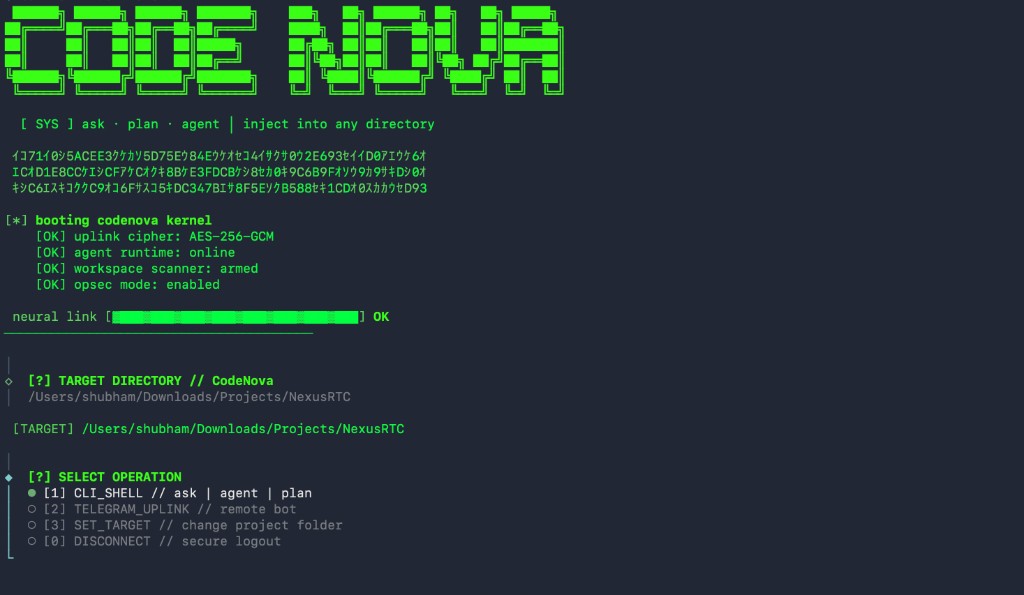
**Startup flow:** figlet CODE NOVA banner → matrix rain + boot spinner → target directory prompt (config/workspace.ts) → command hub ([1] CLI_SHELL, [2] TELEGRAM_UPLINK, [3] SET_TARGET, [0] DISCONNECT). The install directory is never auto-selected as workspace — every session explicitly chooses the project folder.
**Ask mode** (modes/ask/): read-only orchestrator using Vercel AI SDK ToolLoopAgent with tools read_file, list_files, search_files, analyze_codebase, optional Cursor-style skills (SKILLS_DIRS), and optional Firecrawl web tools. Instructions require tool use before answering; replies match the user's language. Optional export appends to .md inside the workspace or notes/.
**Agent mode** (modes/agent/): mutation tools (create_file, modify_file, delete_file, create_folder, run_shell, etc.) stage all changes in memory. runApprovalFlow() lets the user approve all, review one-by-one with diffs, or cancel. applyApprovedFromTracker() writes only approved paths under the workspace root; shell commands are separate approval groups.
**Plan mode** (modes/plan/): generates a JSON plan (1–15 steps), user multiselects steps, each runs an Agent-style loop with the same approval model, then a final apply pass.
**Providers:** default OpenRouter (OPENROUTER_API_KEY, OPENROUTER_DEFAULT_MODEL); alternate direct xAI (AI_PROVIDER=xai). Deprecated Gemini 2.0 IDs map silently to 2.5. On **402 insufficient credits**, generate-with-retry.ts retries once with a lower max_tokens parsed from the error instead of crashing.
**Telegram** (modes/telegram/): Telegraf bot gated by TELEGRAM_OWNER_ID; /ask, /agent, /plan, /workspace, plain text defaults to Ask. Long replies use plain text to avoid Markdown entity breaks on paths with underscores. Ctrl+C gracefully severs uplink and returns to the hub.
**Agent Playground** (examples/agent-playground/): Bun HTTP API + dashboard on port 3847 for safe practice without touching production repos.
Key Engineering Decisions
- •Chose Bun over Node/npm for the primary runtime — peer dependency issues on `marked` and faster installs; repo ships `bun.lock` and documents Bun-only workflow.
- •Workspace-first design: every tool path resolves relative to the user-chosen root, never silently defaulting to CodeNova's own source tree — critical for 'inject into any directory' positioning.
- •Staged mutations + explicit approval for Agent and Plan instead of immediate writes — separates exploration from execution and prevents destructive shell/file ops without consent.
- •Split `terminal/`, `modes/`, `providers/` instead of opaque names (`tui/`, `ai/`) so contributors can navigate boot UI vs orchestration vs model config independently.
- •Implemented 402 retry with capped `OPENROUTER_MAX_OUTPUT_TOKENS` (default 1024) so low-balance OpenRouter accounts get a friendly menu return, not an uncaught stack trace exit.
- •Dual interface (full TUI + optional Telegram) sharing the same mode orchestrators — remote /ask and /agent without reimplementing logic.
- •Matrix-green chalk theme, boot/shutdown sequences, and live session banners (`work-status.ts`) — the TUI communicates mode, codebase, and tool activity (e.g. ▸ read_file) without dumping raw model names.
- •Single-owner Telegram (`TELEGRAM_OWNER_ID`) and `check-env` that prints set/missing vars without ever logging secret values.
Business / Product Thinking
CodeNova targets developers who want **Cursor-like capabilities in any folder** from the terminal — freelancers switching client repos, students practicing on the bundled Agent Playground, or maintainers who prefer CLI over IDE panels. Positioning: **Ask · Plan · Agent** with human-in-the-loop safety, not 'autonomous agent that rm -rf's your project.'
Distribution is GitHub-first (open repo, bun run demo for instant visual hook, cheat sheet for copy-paste). The matrix boot sequence in the screenshot is a strong portfolio differentiator vs generic chat CLIs. Comparable products include Aider, OpenHands CLI, and IDE agents — CodeNova's wedge is polished TUI + three distinct modes + Telegram uplink + workspace picker on every launch.
Monetization is indirect (portfolio, consulting, future hosted team workspaces); the OSS core builds trust. Enterprise angle later: shared approval policies, audit logs of staged commands, and org-wide model routing.
Results & Impact
Shipped open-source CodeNova at github.com/subhm2004/CodeNova (TypeScript 100%, Bun). Live capabilities: Ask/Plan/Agent modes, staged file and shell approvals with diff review, workspace targeting via prompt/flag/env/Telegram /workspace, OpenRouter + xAI providers, 402 credit retry, optional owner-only Telegram bot, matrix boot/shutdown animations, session status banner, Agent Playground on :3847, bun run check-env and bun run demo, and structured docs (modes/README.md, providers/README.md, terminal/README.md, cheat sheet). CLI tagline: inject into any directory — ask, plan, agent.
What I'd Do Differently
Streaming token output in the terminal would make long Agent answers feel responsive. A proper OS-level sandbox (containers or Landlock) would strengthen shell approval beyond path confinement. TURN-free mesh is fine for Telegram text, but rich code blocks might need chunked delivery or a web dashboard. I'd add plugin hooks for custom tools per workspace (e.g. run tests, lint) without forking core. Publishing to npm/bun registry as codenova global binary would lower install friction beyond git clone.
Tech Stack
 OpenRouter